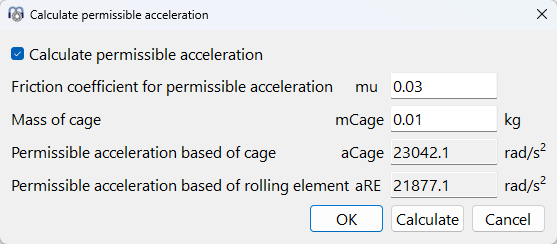
 A simplified approach to calculate a permissible acceleration of a bearing inner ring is available. The permissible calculation is calculated based on forces between the inner ring and the rolling element and a friction coefficient. Only the free contact angle of the bearing is considered, not the actual contact angle under operating conditions, which can be different for inner and outer ring contact.
Spechtel proposes a coefficient of friction of 0.03, which is set as default value. The calculation considers the inertia of the rolling elements and the cage. The later is a separate input. The inertia of the cage is based on its mass and the pitch diameter Dpw.
Two results are available:
•The "permissible acceleration based on cage" is based on the friction of all rolling elements. At this acceleration all rolling elements would slip and therefore the cage speed would be reduced. This case should be avoided always. The inertia of the cage is considered in here.
•The "permissible acceleration based on rolling element" is based on slippage of a single rolling element. The inertia of the cage is not considered in here. In this case the rolling element with the lowest load would slip. This might be permissible in some cases based on experience. If this value is larger than the "permissible acceleration based on cage" the lower values is relevant only.