The thermal expansion setting affects the center distance only. Temperature differences between the gears and the housing are converted into a shift of the center distance tolerances, not into a change of tip diameter or module.
Both gear and housing temperature affect backlash. With the same material and the same temperature, there is no change in backlash. If the gears become warmer than the housing, backlash is reduced for external gearing.
Everything that depends on center distance, such as backlash and contact ratio, changes with temperature. The tip diameter does not change. Temperature is represented purely through the change in center distance, not through a different module for each gear.
The following options are available
•List item "is not considered": No effect of temperature, input fields are hidden, see below screen-shots.
•List item "is considered on one limit only": The upper and lower center distance allowances are both shifted by the same amount based on the thermal expansion.
•List item "is considered on both limits": The limit that is unfavorable is shifted. If the upper thermal shift is negative, it is set to zero. If the lower thermal shift is positive, it is set to zero. As a result, the resulting tolerance field becomes larger, since the original, temperature independent tolerance field remains contained within it. This is not the case when both limits are considered.
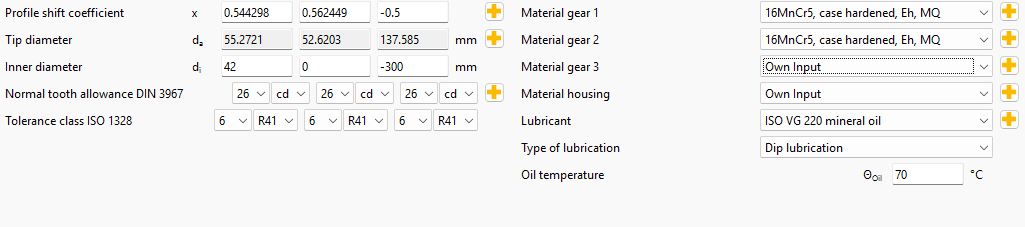
If one of the later two list items is selected, then, the temperature input for the sun, planets and ring gear as well as for the housing is activated in the tab "Geometry". If list item "is not considered" is selected, then, the input of the temperature of the gears and the housing is hidden from tab "Geometry". Temperatures in tab "Geometry" shown, for gears and housing

Temperatures in tab "Geometry" hidden, for gears and housing